
When it comes to upgrading your kitchen with under-cabinet lighting, two options consistently rise to the top: Puck Lights vs Strip Lights. Both have passionate advocates, both can dramatically transform your space, and both offer distinct advantages depending on your needs. But which one is truly better for your cabinet lighting project?
This comprehensive guide Puck Lights vs Strip Lights breaks down everything you need to know about puck lights vs strip lights, from technical specifications and installation requirements to aesthetic outcomes and cost considerations. By the end, you will have a clear understanding of which lighting solution fits your kitchen, budget, and design vision.
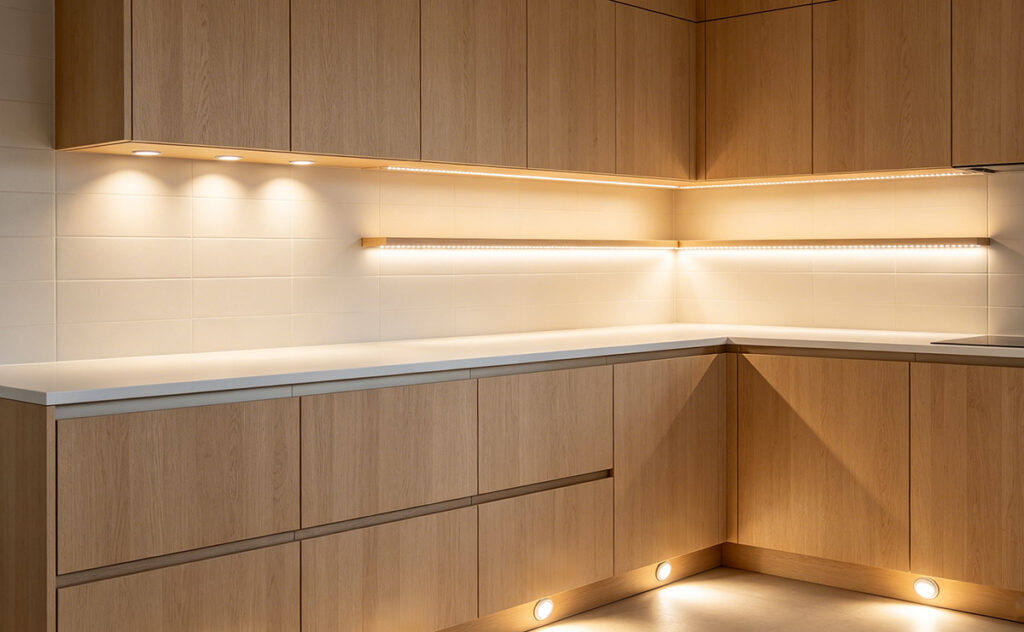
Introduction to Puck Lights and LED Strip Lights
Before diving Puck Lights vs Strip Lights into the comparison, let us clearly define each lighting type so you understand what you are working with .
What Are LED Puck Lights?
LED puck lights are small, round lighting fixtures named for their resemblance to hockey pucks . These compact fixtures are designed to provide focused, directional illumination, making them ideal for highlighting specific areas or objects. They typically measure around 2.75 to 3 inches in diameter and can be either surface-mounted or recessed into the cabinet bottom for a more seamless look .
Modern puck lights use LED technology, offering significant advantages over older halogen or xenon versions, including lower heat emission, longer lifespan, and better energy efficiency. They are available in various color temperatures, from warm white (2700K) to cool white (6500K), and many models offer dimmability and high Color Rendering Index (CRI) ratings of 90 or above .
What Are LED Strip Lights?
LED strip lights, also known as tape lights or ribbon lights, consist of flexible circuit boards populated with multiple small LEDs . These versatile lights can be cut to size, bent around corners, and installed in continuous runs to create seamless, uniform illumination across long stretches of cabinetry .
The flexibility of LED strip lights is their defining feature. They can be installed under cabinets, along shelves, inside display cases, or even above cabinets for indirect lighting effects . With adhesive backing, installation is typically straightforward, though proper planning is essential to hide wiring and achieve professional results.
Technical Comparison: Puck Lights vs Strip Lights
Understanding the technical differences between these two lighting Puck Lights vs Strip Lights options is crucial for making an informed decision. Here is how they stack up across key metrics .
| Feature | LED Puck Lights | LED Strip Lights |
|---|---|---|
| Light Distribution | Focused, directional beam creating pools of light | Continuous, uniform glow across entire run |
| Brightness | Moderate to high, concentrated | High, customizable, spread evenly |
| Flexibility | Limited to fixed positions | Highly adaptable, can bend around corners |
| Installation Complexity | Simple for individual units | Moderate to complex, requires planning |
| Energy Efficiency | Good | Excellent (up to 110LM/W) |
| Lifespan | 50,000+ hours | 50,000 to 80,000 hours |
| Beam Angle | Typically 15-120 degrees | Wide, even distribution |
| Customization | Color temp and dimming options | Length, color, dimming, smart controls |
Light Distribution and Quality: Puck Lights vs Strip Lights
The most significant difference between Puck Lights vs Strip Lights lies in how they distribute light.
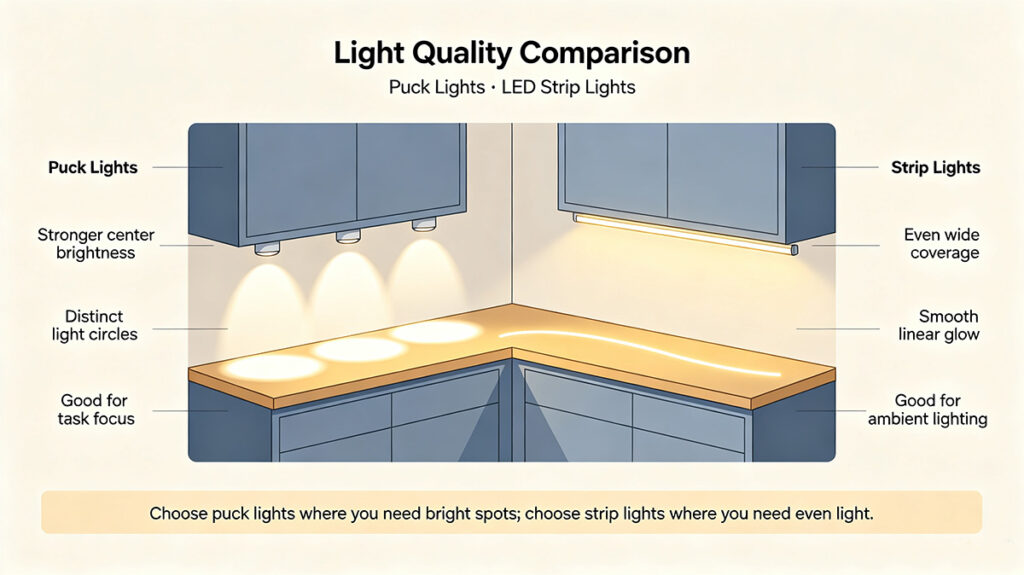
Puck lights create distinct, circular pools of illumination on your countertop . When properly spaced (typically every 8 to 12 inches), these pools overlap to create a “scalloped” effect that many homeowners find visually appealing and cozy . However, if spacing is incorrect, you may end up with dark spots or harsh shadows between fixtures.
LED strip lights, in contrast, provide a continuous, seamless line of light across the entire cabinet run . This uniform illumination eliminates shadows and dark spots, creating a clean, modern aesthetic. The even spread of light makes strip lights particularly effective for task lighting, as there are no gaps in coverage .
Brightness and Beam Angle: Puck Lights vs Strip Lights
For task lighting, both options can deliver adequate brightness, but they achieve it differently.
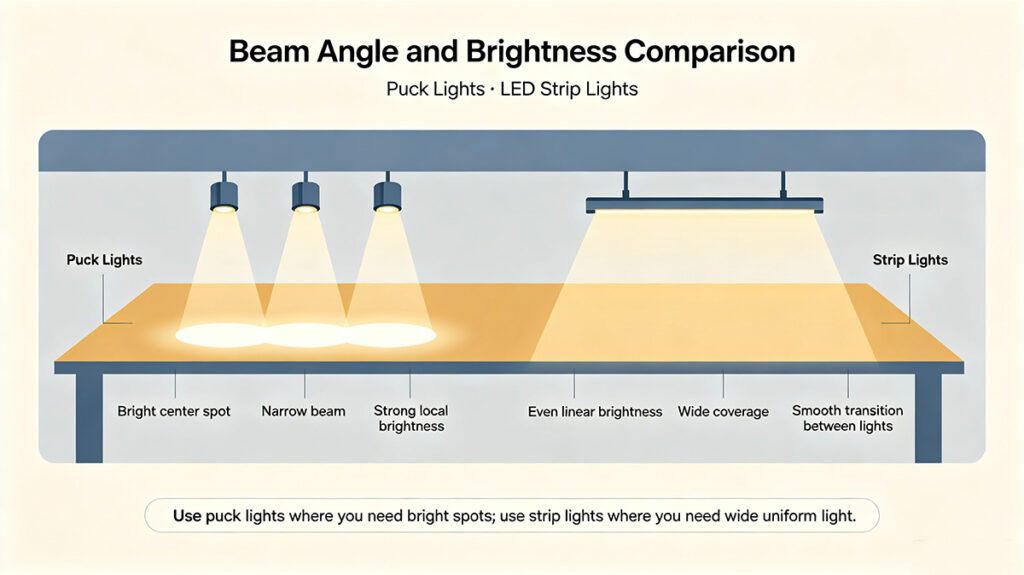
Puck lights concentrate their output into a focused beam, making them excellent for highlighting specific work zones or display items . A wider beam angle (60-120 degrees) is preferred for under-cabinet applications to maximize countertop coverage.
LED strip lights offer impressive luminous flux, with high-quality strips reaching up to 110 lumens per watt . This translates to bright, efficient lighting that can easily illuminate entire countertops without the need for multiple individual fixtures.
Advantages and Disadvantages of LED Puck Lights
Advantages of Puck Lights
Focused Illumination: Puck lights excel at providing targeted, directional light exactly where you need it . This makes them ideal for task-specific applications like food preparation areas, reading nooks, or crafting stations.
Compact and Discreet: Their small size allows them to fit into tight spaces where larger fixtures cannot go . When recessed, they become nearly invisible, creating a clean, minimalist appearance.
Ease of Installation: Puck lights are generally simple to install, especially battery-operated or plug-in models that require no electrical work . Surface-mounted options can be installed with basic tools, making them DIY-friendly.
Aesthetic Appeal: The scalloped light pattern created by puck lights adds warmth and visual interest to kitchen spaces . This traditional lighting style appeals to homeowners seeking a cozy, inviting atmosphere.
Highlighting Capability: Puck lights are perfect for accenting decorative items, artwork, or collectibles in display cabinets or on open shelving .
Disadvantages of Puck Lights
Limited Coverage Area: Each puck light covers only a small area, requiring multiple fixtures for larger spaces . This can increase both material costs and installation time.
Light Overlap Issues: Achieving even illumination requires careful spacing. If lights are placed too far apart, dark spots appear between pools of light .
Less Flexibility: Once installed, puck lights are fixed in position and cannot be easily adjusted or reconfigured .
Potential for Glare: Without diffusers, puck lights can create harsh hotspots and glare on reflective surfaces like granite countertops .
Advantages and Disadvantages of LED Strip Lights
Advantages of Strip Lights
Continuous, Even Illumination: LED strip lights provide shadow-free, uniform lighting across the entire cabinet run . This is ideal for task lighting and makes countertops appear larger and more inviting.
High Flexibility: Strips can be cut to custom lengths, bent around corners, and installed in complex layouts that would be impossible with puck lights .
Excellent Energy Efficiency: LED strips offer outstanding brightness per watt, typically saving 45-70% energy compared to traditional lighting options .
Modern Aesthetic: The seamless, linear glow of strip lights creates a contemporary, high-end look that complements modern kitchen designs .
Versatile Applications: Beyond under-cabinet lighting, strips can be used for toe-kick lighting, shelf illumination, accent lighting, and even outdoor applications with waterproof options .
Disadvantages of Strip Lights
Installation Complexity: While adhesive backing simplifies mounting, proper installation requires careful planning for wiring, power supply placement, and hiding connections .
Higher Initial Cost: Quality LED strip systems often have higher upfront costs compared to basic puck light kits . However, long-term energy savings can offset this investment.
Dimmer Output Potential: Some LED strips produce less brightness than puck light alternatives, which may be a concern for primary task lighting in kitchens . However, high-quality strips with adequate lumen output can match or exceed puck light brightness.
Surface Requirements: Strips require a clean, flat mounting surface. Uneven surfaces or poorly applied adhesive can lead to sagging or premature failure.
Best Applications and Practical Scenarios:Puck Lights vs Strip Lights
Ideal Uses for Puck Lights
Puck lights perform best in scenarios where focused, targeted illumination is needed :
- Under-cabinet task lighting in smaller kitchen areas where precise placement is desired
- Display shelving to highlight specific decorative items, glassware, or collectibles
- Inside glass-front cabinets to showcase dinnerware or china
- Closet and pantry lighting for compact, focused illumination in storage spaces
- Reading nooks or home office areas requiring directed light
Ideal Uses for LED Strip Lights
LED strip lights excel in more versatile, decorative, and detailed applications :
- Kitchen task lighting for broad, uniform under-cabinet illumination across entire countertops
- Ambient and decorative lighting for highlighting architectural features, coves, and furniture
- Toe-kick lighting at the base of cabinets for subtle floor illumination
- Open shelving to create a dramatic, modern display effect
- Media walls and entertainment centers for customizable accent lighting
- Commercial displays and signage requiring bright, flexible lighting solutions
Installation Considerations:: Puck Lights vs Strip Lights
Puck Light Installation
Puck light installation is generally straightforward, particularly for battery-operated or plug-in models :
- Plan spacing: Typically place lights every 8-12 inches for even coverage
- Mark positions: Use a pencil to mark mounting locations
- Mount fixtures: Surface-mount with screws or adhesive, or recess by drilling holes
- Connect wiring: For wired systems, run cables between fixtures and connect to power supply
- Test: Verify all lights function before securing permanently
LED Strip Light Installation
Strip light installation requires more planning but offers greater flexibility :
- Measure and cut: Cut strips to required length at designated cut points
- Plan power supply: Determine driver placement and ensure adequate capacity
- Clean surface: Ensure mounting surface is clean and dry for adhesive
- Route wiring: Plan cable paths to hide connections
- Mount and connect: Apply strips, connect wiring, and test system
Key consideration: LED strips often require additional accessories like connectors, controllers, and power supplies, adding to both cost and installation complexity .
Cost and Energy Efficiency Comparison:Puck Lights vs Strip Lights
Upfront Costs
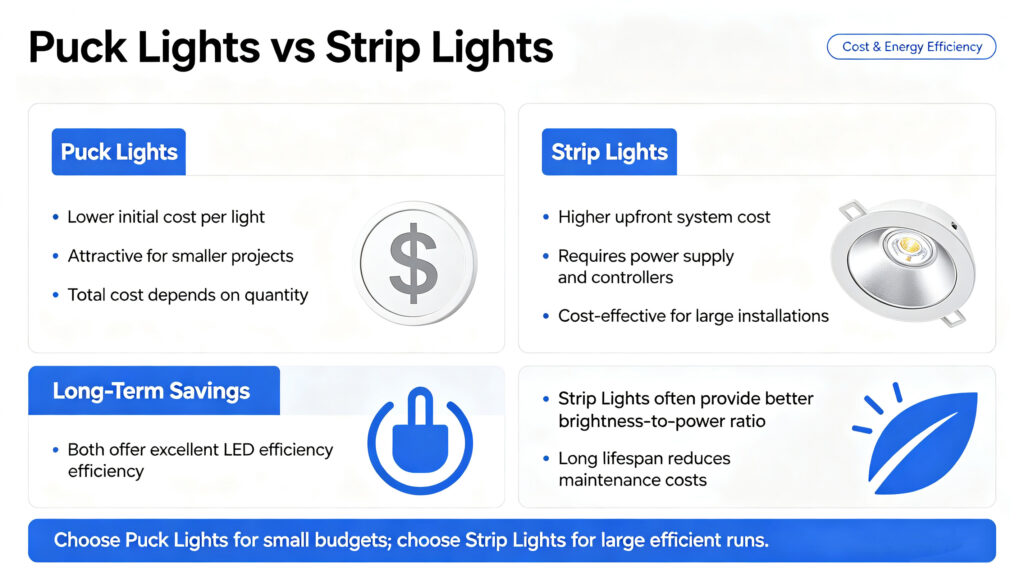
Puck lights generally have lower initial costs per fixture, making them attractive for smaller projects . However, for larger kitchen installations requiring multiple puck lights, the cumulative cost can approach or exceed that of a strip light system.
LED strip lights typically have higher upfront costs due to the need for power supplies, controllers, and accessories . However, for large runs, strips can be more cost-effective than purchasing dozens of individual puck lights.
Long-Term Savings
Both options offer excellent energy efficiency, but LED strip lights often provide superior brightness-to-power ratios . With lifespans of 50,000 to 80,000 hours, both options offer long-term reliability and reduced maintenance costs compared to traditional lighting .
How to Choose Between Puck Lights vs Strip Lights
Decision-Making Framework
Consider these key factors when deciding between puck lights and strip lights :
1. Lighting Effect Desired
- For dramatic, targeted spotlights with traditional appeal: Choose puck lights
- For seamless, modern, uniform illumination: Choose strip lights
2. Installation Preferences
- For simple DIY with minimal planning: Choose puck lights
- For custom installations requiring professional help: Choose strip lights
3. Kitchen Style
- For traditional, cozy, or transitional kitchens: Choose puck lights
- For contemporary, sleek, or minimalist kitchens: Choose strip lights
4. Budget Constraints
- For tighter upfront budgets, especially smaller projects: Consider puck lights
- For long-term value and larger installations: Consider strip lights
The Hybrid Approach: Best of Both Worlds-Puck Lights vs Strip Lights
For the ultimate kitchen lighting design, many homeowners and designers combine both Puck Lights vs Strip Lights . This layered approach allows you to benefit from both technologies:
- Use strip lights under cabinets for general task lighting and even illumination
- Use puck lights inside glass cabinets or on open shelves for focused accent lighting
- This creates depth, dimension, and flexibility in your lighting design
Real-World Scenario Simulation: Which Works for You,Puck Lights vs Strip Lights?
Sometimes, the best way to decide between two technologies Puck Lights vs Strip Lights is to visualize yourself in a real kitchen environment. Here are three common homeowner profiles. Which one sounds most like you?
Scenario 1: The Culinary Enthusiast (Task Lighting Priority)
Profile: You spend hours in the kitchen chopping, prepping, and cooking intricate meals. You need bright, shadow-free light across your entire countertop to see every detail of your ingredients.
Recommendation: LED Strip Lights are your clear winner. Their continuous, linear output ensures that there are no dark gaps between fixtures. When you are dicing onions at the far end of the counter, the light is just as bright as it is in the center. The even spread reduces eye strain and makes food preparation safer. For you, uniformity is not just an aesthetic choice; it is a functional necessity.
Scenario 2: The Home Entertainer (Ambiance & Display Priority)
Profile: You love hosting dinner parties and frequently display your fine china, glassware, or art collection in open shelving and glass-front cabinets. You want your kitchen to look like a showroom at night.
Recommendation: LED Puck Lights are your best ally. Install recessed puck lights inside your glass cabinets to spotlight your favorite serving platters or crystal glasses. The focused, dramatic “scalloped” effect on the countertops creates a warm, inviting atmosphere that is perfect for entertaining. The visual warmth and distinct pools of light add character and a sense of occasion that a continuous strip simply cannot replicate.
Scenario 3: The Modern Minimalist (Design Aesthetics Priority)
Profile: You have a sleek, contemporary kitchen with flat-panel cabinets, quartz countertops, and a clean, uncluttered design language. You hate seeing visible fixtures or uneven lighting.
Recommendation: LED Strip Lights offer the seamless, “floating” look that defines modern minimalist design. When installed properly with an aluminum channel and a diffuser cover, the strip becomes an invisible, integrated part of the cabinetry. The resulting glow is a smooth, uninterrupted line of light that makes the entire kitchen feel like a cohesive, architectural masterpiece.
Long-Term Maintenance and Upgradability:Puck Lights vs Strip Lights
Beyond the initial purchase and installation, considering the long-term maintenance and flexibility of your lighting system is essential for protecting your investment.
Ease of Maintenance:Puck Lights vs Strip Lights
Puck Lights: One of their biggest advantages is simplicity in maintenance. If a single puck light fails, it typically only affects that one fixture . You can easily replace or repair a single unit without disrupting the rest of the system. However, if you are using a plug-in daisy-chain system, a loose connection can sometimes take the whole chain offline, requiring you to trace back through each light to find the fault .
LED Strip Lights: Maintenance on strip lights is generally low because they are incredibly durable, with lifespans extending up to 80,000 hours. However, if a segment of the strip fails, repairs are more complex. You cannot simply replace a single diode; you usually need to replace an entire cut section of the strip and re-solder or reconnect the wiring. For this reason, it is wise to keep some extra strip length and connectors on hand for future repairs .
Future Upgradability and Smart Integration:Puck Lights vs Strip Lights
Puck Lights: Many modern puck lights now come with remote controls, allowing you to switch between color temperatures (e.g., from warm to cool white) or dim them without rewiring . However, integration with smart home systems like Alexa or Google Home is still less common unless you purchase specific, higher-end models.
LED Strip Lights: This is where LED strips truly excel in the long term. They are highly compatible with smart home ecosystems . You can easily add a Wi-Fi or Zigbee controller to your strip system, enabling voice control, scheduling, and even color-changing capabilities (if you opt for RGB or RGBW strips). If your needs change in five years, you can simply swap out the controller without replacing the physical strip, making them an incredibly future-proof investment.
Handling Repairs and Replacements:Puck Lights vs Strip Lights
For puck lights, especially recessed models, accessing the fixture for repair can be tricky if they are tightly fitted into wooden cabinets. Ensure you choose a design that allows for easy removal without damaging the surrounding cabinetry.
For strip lights, the biggest long-term challenge is the adhesive. Over years of use, especially in warmer kitchen environments, the 3M tape may degrade and cause the strip to sag. To future-proof your installation, consider using mounting clips or aluminum channels instead of relying solely on the adhesive backing. Channels also provide better heat dissipation, which extends the strip’s life even further.
Frequently Asked Questions
Q: Are puck lights or LED strips better for under-cabinet lighting?
A: It depends on your priorities. Strip lights offer more even, continuous illumination ideal for task lighting. Puck lights provide focused, dramatic lighting perfect for accenting specific areas . If you can choose only one, strip lights are generally more versatile for kitchen task lighting .
Q: Can I use both puck lights and LED strips in the same kitchen?
A: Absolutely! Combining both creates a layered lighting effect. Use strip lights for general under-cabinet illumination and puck lights for accenting display shelves or glass cabinets .
Q: Are puck lights bright enough for task lighting?
A: Yes, quality LED puck lights provide adequate brightness for focused tasks. However, for extensive or detailed work requiring uniform brightness, LED strips offer a superior solution .
Q: Which option is easier to install?
A: Puck lights are typically easier to install as individual units. Battery-operated models require no wiring at all. LED strips require more planning but are still DIY-friendly with the right preparation .
Q: Do LED strip lights consume more energy than puck lights?
A: LED strips typically offer higher efficiency due to their customizable brightness and spread-out illumination, making them ideal for broader lighting applications .
Q: What color temperature is best for kitchen under-cabinet lighting?
A: The best temperature ranges from 3000K (warm white) to 4000K (cool white) . Cooler temperatures are preferred for task lighting, while warmer tones create a cozier ambiance.
Q: Are puck lights or strip lights more durable?
A: Both are durable when properly installed. LED strips are generally less durable outdoors unless properly enclosed, while puck lights are typically more robust in exposed installations .
Conclusion: Which Should You Choose?Puck Lights vs Strip Lights
The choice between LED puck lights and LED strip lights ultimately comes down to your specific needs, preferences, and kitchen design.
Choose LED puck lights if you:
- Want focused, directional illumination for specific areas
- Prefer a traditional, cozy lighting aesthetic
- Have a smaller project or tighter budget
- Enjoy DIY installation without complex wiring
- Need to highlight decorative items or artwork
Choose LED strip lights if you:
- Want continuous, even, shadow-free illumination
- Prefer a modern, sleek, contemporary aesthetic
- Have larger cabinet runs requiring extensive coverage
- Value energy efficiency and long-term savings
- Want flexibility for future reconfiguration or expansion
And for many homeowners, the answer is not either/or—it is both. Combining puck lights and strip lights creates a layered lighting scheme that offers the best of both worlds: functional task lighting and dramatic accent illumination.
Whatever you choose, upgrading your kitchen with high-quality LED lighting will transform your space, improve functionality, and add lasting value to your home.
Tags
LED puck lights, LED strip lights, under cabinet lighting, puck lights vs strip lights, kitchen cabinet lighting, task lighting, under cabinet LED, kitchen lighting ideas, puck vs strip, cabinet lighting guide, LED strip installation, puck light installation
Request Pricing & Technical Details
Please fill in the form below and our team will reply within 24 hours.