
When homeowners decide to choose LED puck lights for kitchen cabinets, they are often looking for a balance between functionality and style. These compact, round fixtures deliver focused illumination that transforms dark countertops into bright, functional workspaces while adding a touch of elegance to your kitchen design. But with so many options on the market, how do you choose the right LED puck lights for your kitchen cabinets?
This comprehensive guide choose LED puck lights will walk you through every decision point, from understanding basic concepts to selecting the perfect power source, brightness, color temperature, and installation style. Whether you are a DIY enthusiast or working with a professional, by the end of this article you will know exactly what to look for when choose LED puck lights for your kitchen.
Understanding the Basics of Puck Lights for Kitchen Cabinets
Before diving into the selection process, let us establish what makes LED puck lights such an excellent choice for kitchen cabinet lighting.
What Are LED Puck Lights?
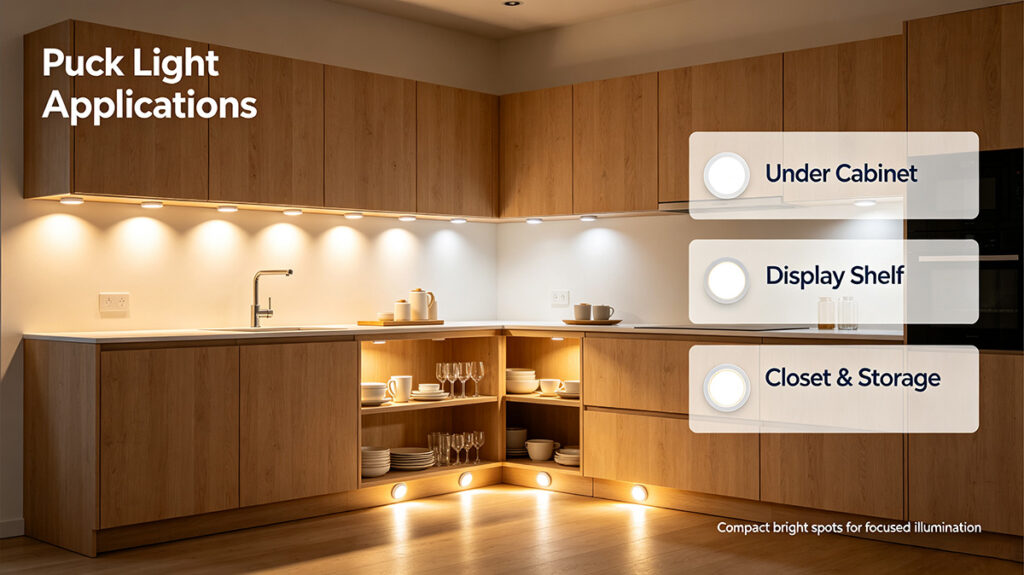
LED puck lights are small, round lighting fixtures named for their resemblance to hockey pucks. Despite their compact size, they provide powerful, focused illumination ideal for task lighting in the kitchen. These lights can be installed under cabinets to brighten countertops, inside cabinets to illuminate contents, or on shelves to highlight decorative items.
Modern LED puck lights offer several advantages over older halogen or xenon models. They are energy-efficient, long-lasting, and generate minimal heat, making them safe to install in confined spaces like wooden cabinets. Most operate on low voltage (typically 12V or 24V), which adds an extra layer of safety and simplifies integration into modern lighting systems.
Common Applications in Kitchens
The versatility of puck lights makes them suitable for various kitchen applications:
- Under-cabinet task lighting: The most popular use, providing shadow-free illumination for food preparation
- Inside glass-front cabinets: Showcasing dinnerware, glassware, or collectibles
- Above cabinets: Creating soft, indirect lighting that adds ambiance
- Inside pantries and drawers: Making it easier to find stored items
- Display shelving: Accenting decorative pieces or cookbook collections
Key Factors to Consider When You Choose LED Puck Lights
Choose LED puck lights involves evaluating several technical and practical factors. Here is what you need to know.
1. How to Choose LED Puck Lights Based on Power Source: Hardwired vs Plug-In vs Battery-Operated
One of the first decisions you will face is how your puck lights will receive power. Each option has distinct advantages depending on your kitchen setup, DIY comfort level, and budget.
Hardwired Puck Lights
Hardwired puck lights connect directly to your home’s electrical system. This provides the cleanest, most professional appearance with no visible cords or plugs. They are controlled by standard wall switches, making operation seamless. However, installation requires more effort, often involving cutting into walls or cabinets to run wiring. This option is best suited for new builds or major kitchen renovations where walls are already open.
Plug-In Puck Lights
Plug-in models connect to a standard wall outlet. Many systems allow you to “daisy-chain” multiple lights together, creating a unified system from a single outlet. Installation is simpler than hardwired options since no electrical work is required. The primary challenge is managing cords, though cable management kits can hide them inside cabinets for a cleaner look. This is an excellent mid-range option for DIY installers.
Battery-Operated Puck Lights
Battery-operated puck lights offer the ultimate convenience for tool-free installation. They typically mount with strong adhesive tape, making them perfect for renters, temporary setups, or locations without accessible power. However, they come with significant trade-offs. User reviews consistently mention that battery-operated models drain power quickly, even when turned off, leading to frequent battery replacements. Additionally, adhesive may fail over time, especially in warm or humid kitchen environments.
Recommendation: For kitchen task lighting that you will use daily, hardwired or plug-in systems are strongly preferred. Battery-operated models are best reserved for occasional use in closets, pantries, or temporary applications.
2. Brightness: Understanding Lumens:choose LED puck lights
Brightness is measured in lumens, not watts. With LED technology, wattage no longer indicates brightness, so always check the lumen output.
For kitchen under-cabinet task lighting, you want sufficient brightness to illuminate your countertop without glare. Here is a general guideline based on application,Use this comparison table to help you choose LED puck lights with the right specifications for your project:
| Application Area | Recommended Lumens per Puck Light |
|---|---|
| Kitchen counter (task lighting) | 200–300 lumens |
| Closet or pantry | 100–200 lumens |
| Accent lighting (shelves, display) | 50–150 lumens |
High-quality LED puck lights typically deliver between 160 and 240 lumens per fixture. Products with around 4W power consumption usually produce 160-200 lumens with excellent efficiency.Evaluating lumens is a critical step when you choose LED puck lights for task-heavy kitchen countertops.
Tip: If you are using puck lights for primary task lighting, aim for the 200–300 lumen range. This provides enough brightness for detailed food preparation without being overpowering.
3. Color Temperature: Kelvin Explained:choose LED puck lights
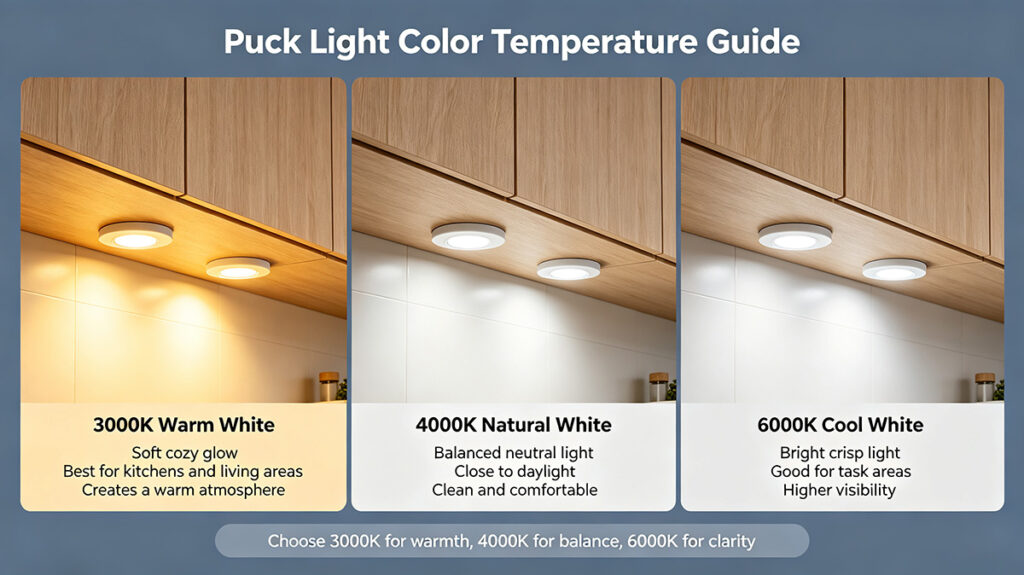
Color temperature determines the “feel” of your light and significantly impacts how your kitchen looks and functions. Measured in Kelvins (K), here is what each range offers:
Warm White (2700K–3000K)
- Produces a soft, cozy, yellowish glow
- Creates inviting atmosphere for dining and entertaining
- Best for: Living spaces, bedrooms, and cozy kitchen nooks
- May make task work more difficult due to warm tones
Neutral White (3500K–4100K)
- Offers a clean, balanced light
- Flatters food and skin tones
- Best for: Kitchens, bathrooms, and display cases
- Good compromise between warmth and functionality
Cool White / Daylight (5000K–6500K)
- Produces bright, crisp, blue-toned light
- Maximizes visibility and contrast
- Best for: Task-heavy kitchens, workshops, and utility areas
- Can feel harsh and clinical in residential settings
Many modern puck lights offer selectable color temperature, allowing you to choose between 3000K, 4000K, or 5000K with a simple switch. Some even offer 2-CCT options that can be programmed for warm or neutral white. This flexibility lets you test different temperatures and adjust to your preference.
Recommendation: For primary kitchen task lighting, 4000K (neutral white) is the most popular choice. It provides clean, bright illumination that makes food preparation easier while remaining pleasant to the eye. For a cozier dining area, opt for 3000K.
4. Color Rendering Index (CRI):choose LED puck lights
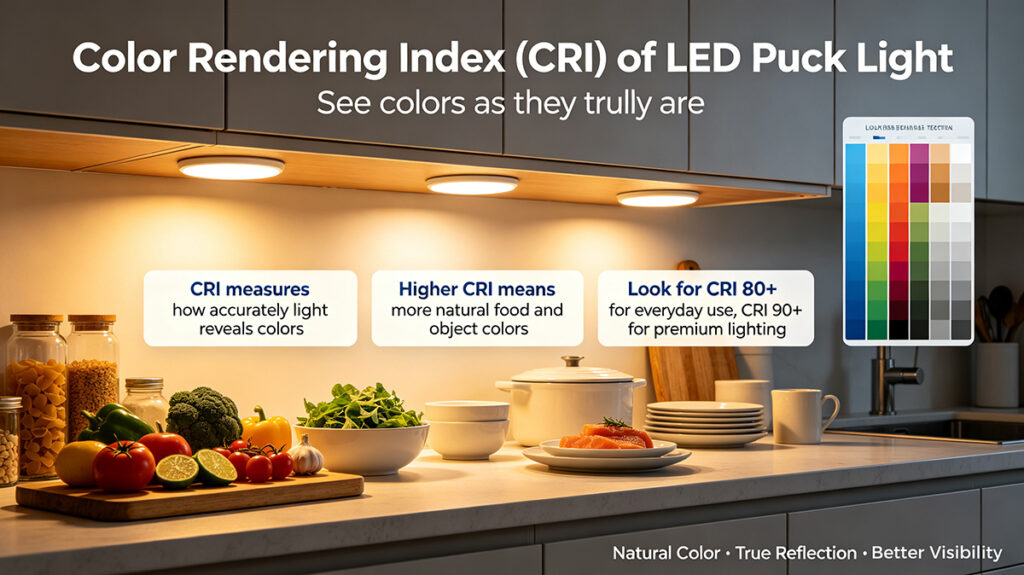
CRI measures how accurately a light source reveals the true colors of objects compared to natural sunlight. On a scale of 0 to 100, sunlight scores 100. For kitchen task lighting, this metric is critical.
When preparing food, you need to distinguish between similar shades—think raw versus cooked chicken, or fresh versus wilted herbs. A low CRI light (below 80) washes out colors, making everything appear dull.
Always choose LED puck lights with a CRI of 90 or higher. High-quality products typically offer 90 CRI, ensuring vibrant, true-to-life colors on your countertops and backsplash. This small investment in quality dramatically improves visual clarity.
5. Mounting Style: Surface-Mounted vs Recessed:choose LED puck lights
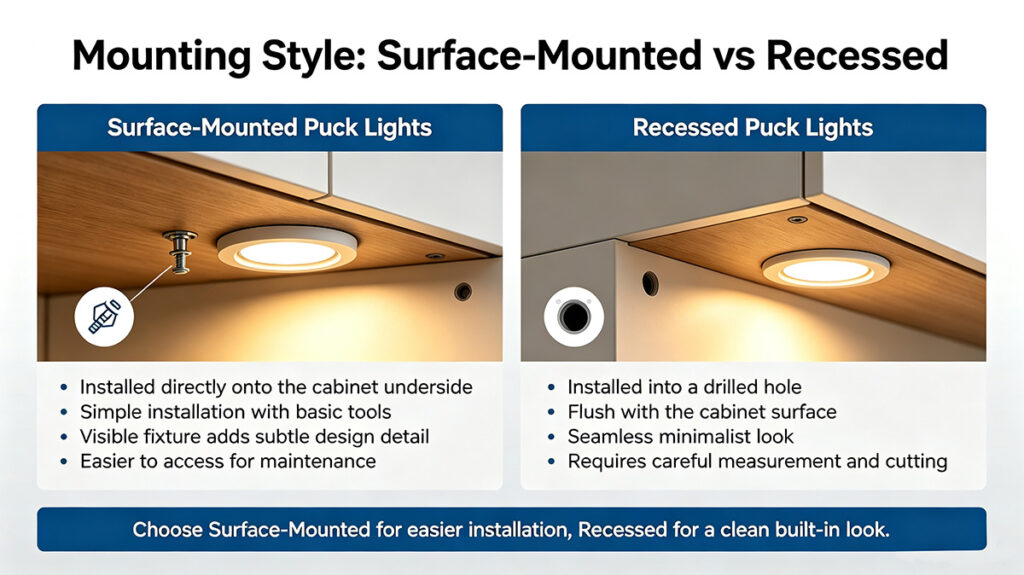
The mounting style affects both aesthetics and installation complexity.Another major decision when you choose LED puck lights is whether to go with surface-mounted or recessed fixtures
Surface-Mounted Puck Lights
- Installed directly onto the underside of the cabinet
- Most common and versatile option
- Simple installation with basic tools
- Visible fixture adds a subtle design element
- Easier to access for maintenance or replacement
Recessed Puck Lights
- Installed into a hole drilled into the cabinet base
- Light sits flush with the surface
- Creates a seamless, minimalist, high-end look
- More complex installation requiring careful drilling
- Requires precise measurement and cutting
Recommendation: Surface-mounted lights are excellent for most DIY projects and rental properties. Recessed lights offer the most professional appearance but require more installation skill. Products like the Orion HP puck light feature a slim profile and magnetic finish plate, making recessed installation more accessible.
6. Size and Design Compatibility:choose LED puck lights
Puck lights come in various sizes, typically ranging from 2.75 to 3 inches in diameter. Before purchasing, measure your intended installation space.
Consider the following:
- Available depth: If recessing, ensure the cabinet bottom is thick enough to accommodate the fixture
- Finish options: Many models come in white, black, brushed nickel, or stainless steel to match cabinetry and hardware
- Visual appeal: Will the fixture complement your kitchen design or clash?
7. Dimmability and Control Options:choose LED puck lights
Dimmability adds significant flexibility to your lighting. It allows you to adjust brightness for different tasks or moods—bright for food prep, softer for dining or entertaining.
Many LED puck lights offer dimming capabilities through various controls:
- Remote control: Convenient for adjusting from across the room
- Wall switch: For hardwired installations
- Motion sensors: Ideal for closets or pantries, turning on automatically when you enter
- Smart home integration: Some models work with Alexa or Google Home
If dimmability is important to you, verify that both the puck lights and any dimmer switches are compatible. Not all LED fixtures work with all dimmer types.
8. Selectable Color Temperature (CCT):choose LED puck lights
One of the most convenient innovations in LED puck lights is selectable CCT. This allows you to choose between warm, neutral, or cool white output at the flip of a switch.
For example, the Orion HP puck light allows selection of 3000K, 4000K, or 5000K, all in one product. This flexibility is perfect if you are unsure which temperature suits your kitchen best. You can experiment and find the perfect balance without returning products.
Practical Installation Considerations:choose LED puck lights
Even the best puck lights will disappoint if installed incorrectly. Here are essential installation factors to consider.
Spacing for Even Coverage:choose LED puck lights
To avoid dark spots or harsh shadows, proper spacing is critical. A general guideline is to place puck lights every 12 to 18 inches apart under cabinets. For high-lumen fixtures, you may stretch to 18 inches; for lower output, stick closer to 12 inches.
Wiring Options:choose LED puck lights
For wired systems, you have two primary options:
Hidden Wiring: Drill holes in the cabinet bottom to run cables up and inside, completely out of sight. This offers the cleanest appearance but requires more work.
Surface Wiring: Route cables flat against the cabinet surface using the notch in the mounting ring. This is easier but leaves cables visible.
Power Supply Requirements:choose LED puck lights
Most LED puck lights operate on low voltage (12V or 24V) and require a compatible driver (power supply) to convert household current. When planning your system:
- Add up the total wattage of all connected puck lights
- Ensure the driver capacity is at least 20% higher than the total wattage
- This prevents overheating and premature failure
Some products, like the Inlight puck light, operate on standard 120V line voltage, eliminating the need for a driver.
Location Type Rating:choose LED puck lights
For kitchen use, verify the product is rated for dry or damp locations. Most under-cabinet installations are dry, but if installing near a sink, consider damp-rated fixtures.
Understanding Common Pitfalls and How to Avoid Them:choose LED puck lights
Learning from others’ mistakes can save time, money, and frustration. Here are common issues to avoid when choosing and installing puck lights:
Overlooking Power Requirements: Insufficient power supply planning is a frequent mistake. Always calculate total wattage and select an appropriately sized driver.
Poor Spacing: Irregular placement creates shadows or bright spots. Plan your layout carefully and mark positions before installation.
Ignoring Battery Drain: Battery-operated lights can be convenient, but many users report they drain batteries quickly, even when off. If opting for battery models, choose rechargeable batteries to minimize ongoing costs.
Failing Adhesive: Adhesive mounting is convenient but may fail over time, especially in warm kitchen environments near ovens or toasters. Consider screw mounting for permanent installations.
Non-Dimmable Fixtures: Choosing lighting without dimmer support limits ambiance options. If you want flexibility, select dimmable models from the start.
Cost Considerations and Value:choose LED puck lights
Puck light pricing varies widely based on type, quality, and features:
- Basic battery-operated sets: Often $2-5 per light
- Wireless kits with remote and dimming: $5-15 per light
- Hardwired, high-CRI, selectable CCT models: $15-30+ per light
While it may be tempting to choose the cheapest option, consider long-term value. Higher-quality LED puck lights offer:
- Lifespan: Quality models last 50,000+ hours, translating to years of daily use
- Energy efficiency: Lower operating costs over time
- Better light quality: Higher CRI and consistent brightness
- Reliability: Fewer failures and less maintenance
Many premium products include 5-year warranties, providing peace of mind for your investment.
Frequently Asked Questions
Q: How do I choose LED puck lights quantity for my kitchen layout?
A: A general rule is one puck light for every 12 to 18 inches of cabinet space. For a standard 36-inch cabinet section, you will typically use 2 to 3 lights for even illumination.
Q: Are LED puck lights worth the investment?
A: Yes. LED puck lights are energy-efficient, have longer lifespans compared to traditional bulbs, and provide excellent task lighting. They significantly improve kitchen functionality and aesthetics.
Q: Can I install puck lights myself?
A: Many puck light kits include straightforward instructions perfect for DIYers. Battery-operated and plug-in models are particularly beginner-friendly. For hardwired installations, if you are comfortable with basic electrical work and follow safety guidelines, you can DIY, but contact a professional if unsure.
Q: Are battery-powered puck lights bright enough for cooking?
A: Many modern battery-powered LEDs offer surprisingly bright light suitable for most cooking prep. However, for consistent, powerful illumination, hardwired LEDs typically perform better.
Q: Can puck lights be dimmed?
A: Absolutely. Many puck lighting systems offer dimmable options via remote control, switches, or smart home integration. This allows you to set the perfect mood or task brightness easily.
Q: What finish should I choose?
A: Choose LED puck lights finish that complements your cabinetry and hardware. Popular options include white, black, brushed nickel, and stainless steel.
Q: How long do LED puck lights last?
A: Quality LED puck lights can last 25,000 to 50,000 hours or more, translating to years of daily use. Proper installation and regular cleaning help maximize lifespan.
Conclusion
Choose the right LED puck lights for your kitchen cabinets does not have to be overwhelming. By focusing on the key factors outlined in this guide—power source, brightness (lumens), color temperature (Kelvin), color rendering (CRI), and mounting style—you can confidently select the perfect fixtures for your space.
Summary Checklist for Choose LED Puck Lights:
☐ Determine power source: Hardwired, plug-in, or battery-operated
☐ Calculate required brightness: 200-300 lumens for task lighting
☐ Select color temperature: 4000K for kitchens, 3000K for cozy spaces
☐ Verify CRI of 90 or higher for accurate color rendering
☐ Choose surface-mounted or recessed based on aesthetics and skill level
☐ Confirm dimmability if flexibility is important
☐ Plan spacing: 12-18 inches between fixtures
☐ Check size and finish compatibility with your kitchen design
☐ Account for power supply requirements if using low-voltage system
Whether you are undertaking a full kitchen remodel or simply adding a quick lighting upgrade, the right LED puck lights will transform your kitchen into a brighter, more functional, and more inviting space. Invest in quality, plan carefully, and enjoy the benefits of beautiful under-cabinet lighting for years to come.
Ready to Transform Your Kitchen Today?
Do not let poor lighting diminish your cooking experience or the beauty of your cabinetry. Armed with this buying guide, you are now equipped to make a confident decision. Browse our curated collection of premium LED puck lights and find the perfect fit for your home. Upgrade your kitchen lighting today—your counters (and your eyes) will thank you!
Tags
choose LED puck lights, LED puck lights, under cabinet lighting, kitchen cabinet lighting, puck light buying guide, how to choose puck lights, kitchen task lighting, LED under cabinet lights, puck light installation, kitchen lighting ideas, puck light brightness, color temperature for kitchen, CRI lighting, recessed puck lights, battery operated puck lights
Request Pricing & Technical Details
Please fill in the form below and our team will reply within 24 hours.