
If you’re planning to install under cabinet lighting, one of the first decisions you’ll face is how to power it. Should you hardwire the lights directly into your home’s electrical system? Or simply plug them into a nearby outlet?
The short answer: It depends on your budget, whether you’re renovating, and how permanent you want the installation to be. Hardwired lighting offers the cleanest, most professional look but requires an electrician. Plug‑in lighting is a quick, DIY‑friendly solution that can be installed in minutes.
Let’s break down both options so you can decide which is right for your kitchen.
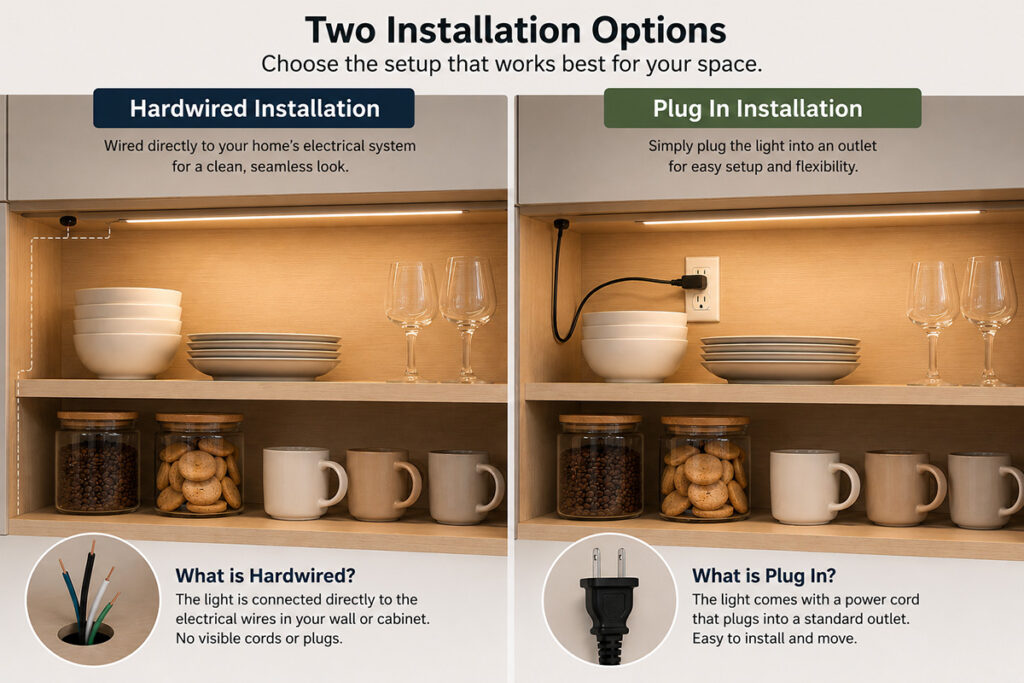
What’s the Difference?
| Feature | Hardwired Installation | Plug‑In Installation |
|---|---|---|
| Best for | New construction, full remodels | Existing kitchens, DIY projects, renters |
| Aesthetic | Seamless, no visible cords | May have visible cords (can be hidden) |
| Installation | Requires a licensed electrician | DIY, 15‑30 minutes |
| Cost | $250–$800+ (fixtures + labor) | $50–$250 (DIY kit) |
| Control | Wall dimmer / smart hub | Individual switch / remote / smart plug |
| Portability | Permanent, stays with the home | Can be taken when you move |
Hardwired Under Cabinet Lighting: The Permanent Standard
Hardwired lights connect directly to your home’s 120V electrical system, usually via a wall switch or dimmer. They’re considered the gold standard for a seamless, professional look.
Why Choose Hardwired?
Clean, Cord‑Free Appearance
With hardwired lights, there are no power cords running down your backsplash. The result is a kitchen that looks polished and high‑end.
Centralized Dimming and Control
Hardwired systems let you control the entire under‑cabinet run from a single wall dimmer — offering a much smoother dimming experience than small onboard switches.
No Outlet Needed
Hardwired lights don’t occupy your valuable kitchen outlets, leaving them free for appliances.
Potential Home Value Increase
Hardwired lighting adds permanent electrical infrastructure, which can increase your home’s appraised value.
What to Consider
Installation Requires an Electrician
Hardwiring is not a typical DIY project. You’ll need a licensed electrician, which adds $250–$800+ to your budget.
More Invasive Installation
If your walls already have a finished backsplash, running new wires may require cutting into drywall or tile.
GFCI/AFCI Compliance
Many local codes require kitchen lighting circuits to be protected by GFCI and Arc Fault breakers. Make sure your LED driver is “high‑power‑factor” rated to prevent nuisance tripping.
Best Timing
Hardwired lighting is most practical during a kitchen renovation, when running power can blend in with other electrical work.
Plug‑In Under Cabinet Lighting: The DIY Powerhouse
Plug‑in systems are exactly what they sound like — you mount the lights and plug them into a standard outlet.
Why Choose Plug‑In?
Quick and Easy Installation
No electrician needed. Most plug‑in lights can be installed in 15–30 minutes with just a screwdriver or even adhesive tape.
Much Lower Cost
Starting under $100 for a basic DIY kit, plug‑in lighting is significantly more budget‑friendly than hardwired options.
Renter‑Friendly
If you’re renting or plan to move, plug‑in lights can be taken with you. Many renters use them in Airbnbs or apartments without modifying the property.
Linkable Flexibility
Many plug‑in systems allow you to “daisy‑chain” multiple fixtures together, so one plug powers an entire run of cabinets.
What to Consider
Visible Cords
Even with good cable management, you may see a cord running to the outlet. However, you can use cable clips or raceways to keep wires tidy.
Occupies an Outlet
Kitchen outlets are prime real estate for coffee makers, air fryers, and other appliances. A plug‑in system takes one away permanently.
Power Supply (Driver) May Be Extra
Many LED systems require a separate driver or power adapter. In some kits, the power supply is sold separately.
The Best of Both Worlds: Dual‑Power “Hybrid” Fixtures
One of the latest innovations is the dual‑power fixture — designed with internal “knockouts” for hardwiring and compatible ports for plug‑in accessories.
The Strategy: Buy the fixture today and plug it in for an immediate DIY installation. If you remodel later, your electrician can remove the cord and hardwire the same fixture directly into the wall.
This approach gives you maximum flexibility and is the most future‑proof investment for any homeowner.
Quick Summary: Which Should You Choose?
| Your Situation | Best Choice |
|---|---|
| You’re doing a full kitchen remodel | Hardwired — seamless look, adds value |
| You’re on a tight budget | Plug‑in — much cheaper, DIY install |
| You rent or might move soon | Plug‑in — portable, no electrical work |
| You want a professional look but can’t hardwire | Plug‑in — can be installed neatly with cable management |
| You want to keep options open | Dual‑power — supports both methods |
Hardwired is typically the right choice if you want the absolute cleanest, most permanent installation — but only if you’re already renovating or willing to pay for an electrician. Plug‑in is the clear winner for quick upgrades, small budgets, or rental properties.
Looking for under cabinet lights for your project?
We supply LED under cabinet lighting with multiple color temperature options (3000K, 4000K, 6000K), certified adapters for EU (CE/RoHS) and US (UL) markets, and flexible power solutions to match your installation needs.
📩 Contact us to discuss your requirements and get a quote.
#UnderCabinetLights #KitchenLighting #HardwiredLighting #PlugInLighting #HomeImprovement #LEDLighting #DIYKitchen
Request Pricing & Technical Details
Please fill in the form below and our team will reply within 24 hours.