
How Does A Door Trigger Switch Work? (Infrared Type)
If you’ve ever opened a kitchen cabinet or wardrobe and had the light turn on automatically — without touching any button — you’ve experienced a door trigger switch in action.
But here’s the thing: not all door trigger switches use magnets. Many modern cabinet lights use infrared (IR) door trigger switches. They’re simpler, more reliable, and easier to install.
Let’s break down exactly how they work.
What Is a Door Trigger Switch?
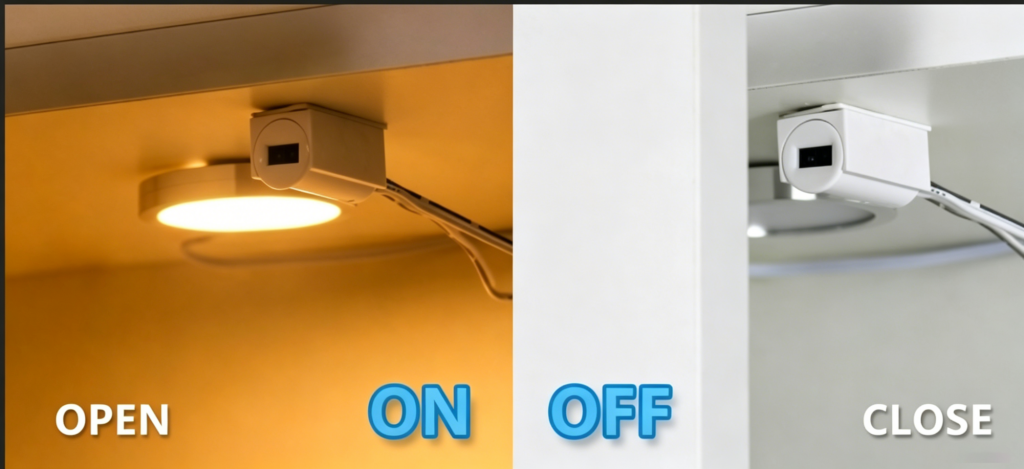
A door trigger switch (also called a door sensor or door contact switch) is a device that detects whether a door or cabinet is open or closed. When the door opens, the switch triggers the light to turn on. When it closes, the light turns off.
In cabinet lighting, there are two main types of door switches:
| Switch Type | How It Works | Common Use |
|---|---|---|
| Magnetic (Reed Switch) | Uses a magnet and a magnetic switch | Older designs, some security systems |
| Infrared (IR) Door Switch | Uses infrared light reflection | Modern cabinet lights, wardrobes, drawers |
Our products use the infrared type — no magnets, no moving parts.
How Does an Infrared Door Switch Work?
Infrared door switches work on a simple principle: light reflection.
The switch has two key components inside:
| Component | Function |
|---|---|
| IR Transmitter (LED) | Sends out a beam of infrared light |
| IR Receiver (Phototransistor) | Detects whether the light bounces back |
Here’s what happens step by step:
Step 1: Door is Closed
- The door is right next to the switch
- The IR transmitter sends out infrared light
- The light reflects off the door surface and bounces back to the receiver
- The receiver detects the reflected light → circuit stays off
Step 2: Door Opens
- The door moves away from the switch
- The IR light is no longer reflected back
- The receiver detects no signal
- The switch triggers the circuit → light turns on
Step 3: Door Closes Again
- The door comes back into position
- The IR light reflects off the door again
- The receiver detects the reflection → circuit turns off
Infrared vs Magnetic Switch: Which Is Better?
| Comparison | Infrared Switch | Magnetic (Reed) Switch |
|---|---|---|
| Components | IR emitter + receiver | Magnet + reed switch |
| Moving parts | None | Yes (the reed blades move) |
| Lifespan | Longer (no wear and tear) | Limited (mechanical wear) |
| Installation | Simple, one component | Two components (magnet + switch) |
| Sensitivity | Adjustable | Fixed |
| Cost | Lower | Slightly higher |
| Best for | Modern cabinet lights, drawers | Security systems, traditional designs |
Infrared switches are better for cabinet lighting because:
- No magnets to lose or misalign
- Only one component to install
- No moving parts means longer life
- More reliable for frequent door opening/closing
Where Are Infrared Door Switches Used?
1. Cabinet and Wardrobe Lighting
- Open the door → light turns on automatically
- Perfect for dark closets, pantries, and kitchen cabinets
- Especially common in closed furniture like wardrobes and drawers
2. Drawer Lighting
- Pull open a drawer → light illuminates the contents
- Push it closed → light turns off
3. Display Cabinets
- Open the glass door → items are highlighted
- Close the door → lights off to save energy
4. Slide Door Applications
- The infrared sensor detects when the door slides open
Technical Details (For Buyers & Specifiers)
If you’re sourcing infrared door switches for your lighting products, here are the key specs to know:
| Parameter | Typical Range | Notes |
|---|---|---|
| Operating Voltage | DC 12V / 24V | Most common for LED cabinet lights |
| Load Power | Up to 60W (12V) / 120W (24V) | Check your light’s power consumption |
| Sensing Distance | 2–5 cm | Recommended gap between door and switch |
| Mounting | Flush mount or surface mount | Can be hidden inside cabinet frames |
| Housing Material | ABS or PA66 plastic | Durable and moisture-resistant |
The sensor works by detecting the presence or absence of reflected infrared light.
Installation Tips
- Mount on the door frame, not the door itself
- The sensor should face the inside surface of the door when closed
- Keep the gap between sensor and door within 2–5cm for reliable detection
- Avoid placing the sensor where it might be blocked by objects inside the cabinet
- For drawers, install the sensor at the back of the drawer opening

Summary
An infrared door trigger switch is:
- Simple: uses infrared light reflection to detect door position
- Reliable: no moving parts, no magnets to lose
- Easy to install: one component, simple wiring
- Cost-effective: lower cost than magnetic alternatives
For cabinet lights, wardrobes, and drawers, the infrared door switch is the smart choice.
Ready to add infrared door switches to your cabinet lighting?
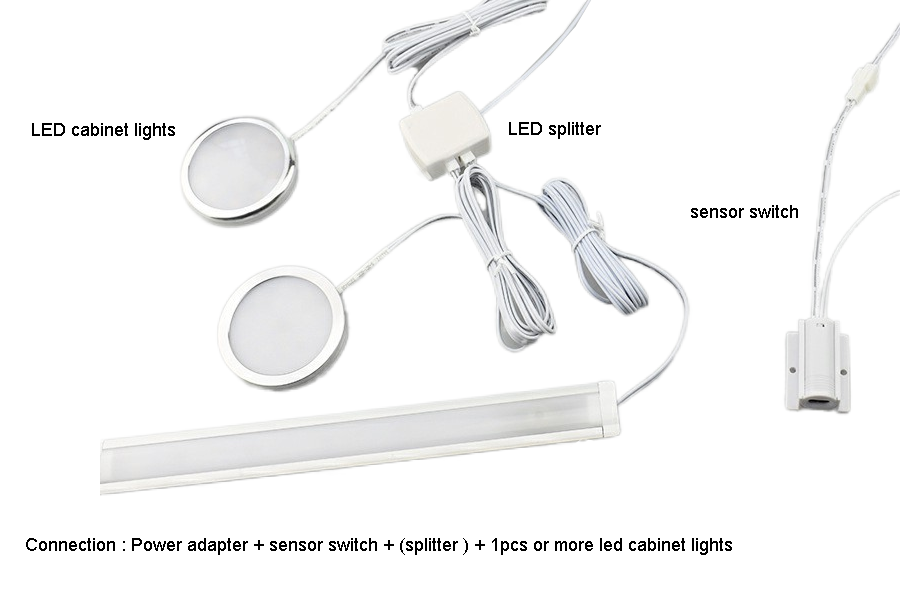
We supply infrared door trigger switches for cabinet lights, wardrobe lights, and display case lighting — 12V/24V, customizable wire lengths, and certifications for EU (CE/RoHS) and US (UL adapter) markets.
📩 Contact us to discuss your specifications and get a quote.
#DoorTriggerSwitch #InfraredSwitch #CabinetLighting #WardrobeLighting #LEDLighting #SensorSwitch
Request Pricing & Technical Details
Please fill in the form below and our team will reply within 24 hours.